
Why this story matters: Behind the high-level statistics and political debates, there are real people making a real difference. This article brings one of those stories to light, showcasing the incredible power of collective determination.
Quick summary: This story highlights recent developments related to nutrition wellness, showing how constructive action can lead to meaningful results.
BY THE OPTIMIST DAILY EDITORIAL TEAM
You know the skincare aisle. You’ve stood there long enough to know that the options are overwhelming and the prices are humbling: serums, creams, collagen-boosting masks, each one promising the same thing in a slightly different bottle. A good topical routine does matter. But even the most expensive serum only works on the surface. It can’t give your skin what it needs to rebuild from the inside.
The vitamins your body uses to make collagen, the antioxidants that keep inflammation in check, the healthy fats that hold the skin barrier together: all of it has to come from food. No single meal turns back the clock, but the right ingredients, eaten consistently, make a real difference over the years.
Here are ten worth building into your plate.
Vegetables that pull their weight
Broccoli
Broccoli earns its overachiever reputation. It carries vitamins C and K, calcium, folate, fiber, and lutein, the same nutrient linked to better memory and brain function. For skin, the vitamin C is the workhorse: your body needs it to produce collagen, the protein that keeps skin firm and elastic. The calcium and vitamin K support bone health and help ward off osteoporosis. Few vegetables do this much at once.
Raw works fine for a snack. Lightly steaming it makes certain nutrients more available. It holds up well roasted, blended into pesto, or added to whatever you’re already making.
Red bell peppers
Red bell peppers have more vitamin C than most people expect, which makes them consistently useful for collagen. They also contain carotenoids, the pigments behind the vivid reds, oranges, and yellows you see across produce. Carotenoids have solid anti-inflammatory credentials, and since chronic inflammation drives accelerated skin aging, that matters in practice, not just on paper.
Slice them for hummus, add them raw to a salad, or cook them into a stir-fry.
Spinach
Spinach is deeply hydrating and carries vitamins A, C, E, and K alongside magnesium, iron, and lutein. Vitamin C supports collagen; vitamin A may play a role in hair health; vitamin K turns up in several of the body’s metabolic processes. It disappears into a smoothie, wilts in minutes in a sauté, and works as a salad base without any effort at all.
Sweet potatoes
The orange color in sweet potatoes comes from beta-carotene, which the body converts to vitamin A, a nutrient tied to skin elasticity and cell turnover. Sweet potatoes also carry vitamins C and E, which may help protect skin from oxidative damage. They’re starchy, yes, but dense with nutrients.
Watercress
Watercress gets overlooked next to kale and spinach, which is a shame. It packs calcium, potassium, manganese, phosphorus, and vitamins A, C, K, B1, and B2 into a small peppery leaf that also supports immune function, digestion, eye health, and heart health. Those benefits tend to matter more the older you get. Try it as a grain bowl base or folded into a salad where you’d normally use arugula.
Fruits that earn a regular spot on your plate
Avocados
Avocados are high in monounsaturated fats with anti-inflammatory properties, and a 2022 study found that eating one daily was linked to better skin health in women specifically. They’re also a reliable source of vitamins K, C, E, A, several B vitamins, and potassium. Here’s the part worth knowing: the fat in avocados helps your body absorb fat-soluble nutrients from whatever else is on the plate. So the avocado you slice into a salad is also helping you get more out of the spinach underneath it.
Blueberries
Blueberries carry vitamins A and C along with a range of other nutrients, and they may help protect skin from sun damage by reducing inflammation and slowing collagen loss, though research here is still developing. They’re low in sugar, taste good, and take seconds to add to a smoothie or bowl. Hard to argue with.
Papaya
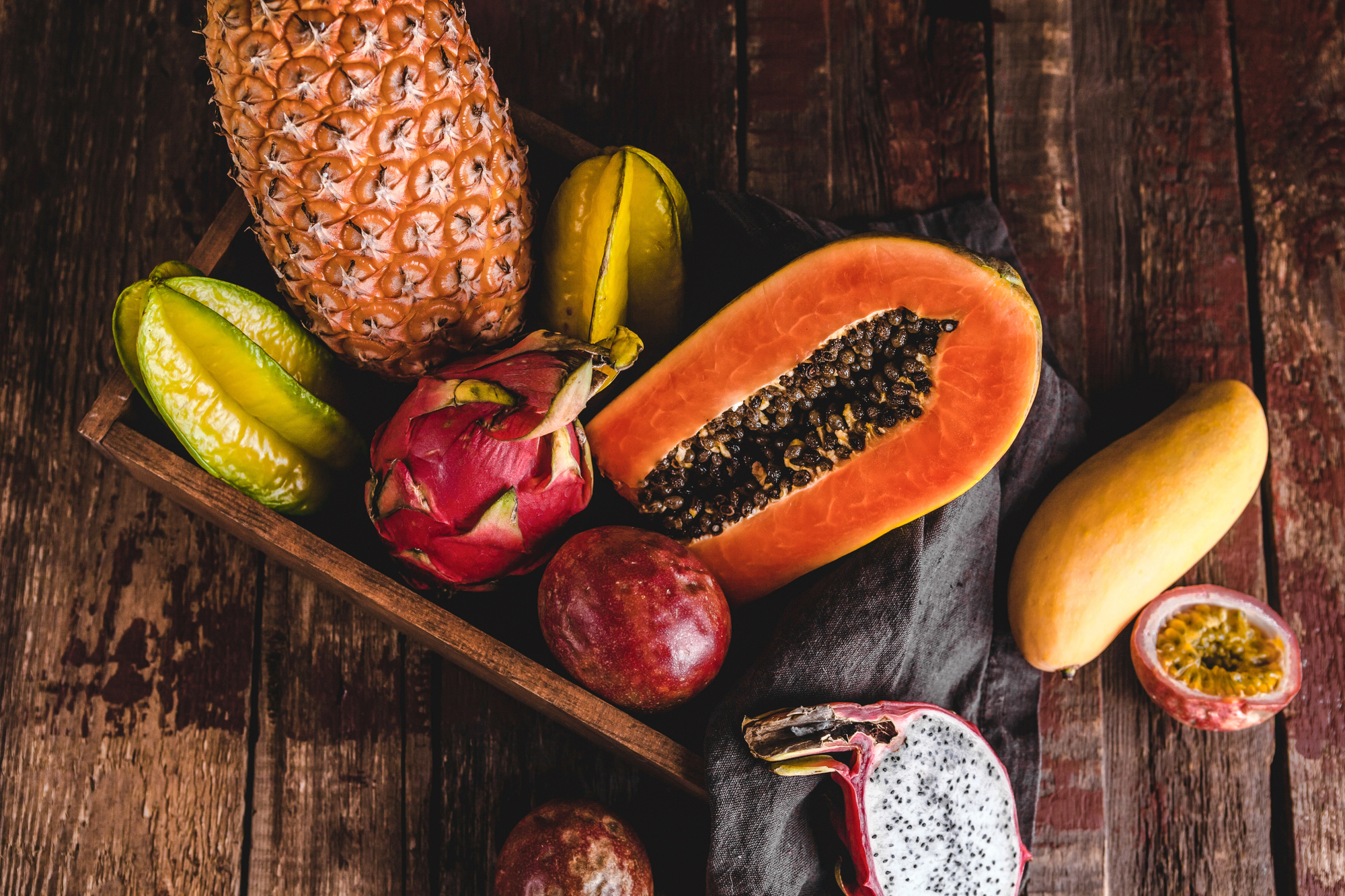
Papaya is nutrient-dense in a way that surprises people: vitamins A, C, K, and E, calcium, potassium, magnesium, phosphorus, and B vitamins, plus papain, an enzyme that aids digestion. Fermented papaya has been studied specifically for reducing age-related effects on the body. Some research has also linked it to a possible reduced risk of Alzheimer’s and dementia, though that work is still in early stages. The simplest way to eat it: fresh slices with a squeeze of lime for breakfast.
Nuts and seeds
Nuts
Most nuts are a reliable source of vitamin E, which helps repair skin tissue, supports moisture retention, and may offer some protection against UV damage. Almonds are the most concentrated source; pistachios have been linked to lower type 2 diabetes risk; walnuts bring omega-3 fatty acids that support the skin’s cell membranes and heart health. One thing to know: if you eat almonds, leave the skin on. Research puts 50 percent or more of their antioxidant content in that outer layer.
Pomegranate seeds
Pomegranates have been used medicinally for centuries, and science is starting to explain why. They carry vitamin C and antioxidants that may reduce free radical damage and lower systemic inflammation. The peel and extract contain punicalagin, a compound with anti-inflammatory properties. There’s also urolithin A, produced when gut bacteria break down pomegranate compounds, that may support mitochondrial health. Early animal studies hint at a connection to muscle function as we age. That hasn’t been confirmed in humans yet, but it’s one of the more interesting threads in aging research right now.
Scatter pomegranate seeds over a spinach and walnut salad, and you’ve brought several of these foods together without trying very hard.
Building a plate that works for your skin
Consistency is the whole point. No single food makes or breaks your skin, and no diet undoes time. What it can do is build a better foundation, one that pays out slowly over years of eating well. The easiest starting point is color: deep reds, purples, and oranges signal high antioxidant concentration. The more variety on your plate, the more your skin has to draw from.
Did this solution stand out? Share it with a friend or support our mission by becoming an Emissary.
BluAZ.com curates positive and solution-focused stories from trusted sources around the world.


 Why this story matters: In an era where the digital landscape is often flooded with polarizing and negative headlines, stories like this se...
 Mexico Bans Captive Marine Mammals in Entertainment In a groundbreaking move, Mexico’s Congress unanimously approved a reform to the General...
 Why this story matters: In a world where it is easy to feel overwhelmed by the scale of our problems, stories of localized innovation and c...
 Why this story matters: We live in a time that often emphasizes our differences, but stories of community and collaboration remind us of ou...
 Why this story matters: Innovation isn't just about the latest gadget; it's about making life better for everyone. This story highl...
 Why this story matters: While we must remain clear-eyed about the challenges that remain, it is equally important to acknowledge the victor...
 Why this story matters: In this week’s highlight of positive developments, we look at a story that reminds us that progress is a choice we ...


Please be good and do not spam. Thank you.