
Why this story matters: Stories like this remind us that improvement often comes through small, steady efforts.
Quick summary: This story highlights recent developments related to creature, showing how constructive action can lead to meaningful results.
In 2025, a student-led team of researchers at Tohoku University in Japan discovered a massive Physalia, or Portuguese man o’ war, that boasted a striking blue cobalt color.
Upon close examination, it turned out to be a new species.
And they came across it by happenstance.
Would you like to read more good news about Creature, Avatar, Newlydiscovered, Universe, Jellyfish, and Looks?
“I was working on a completely different research project around Sendai Bay in the Tohoku region, when I came across this unique jellyfish I had never seen around here before,” student researcherYoshiki Ochiai told Tohoku University. “So, I scooped it up, put it in a ziplock bag, hopped on my scooter, and brought it back to the lab!”
According to Professor Cheryl Ames of the Graduate School of Agricultural Science and the Advanced Institute for Marine Ecosystem Change, the new species is named Physalia mikazuki, or “crescent helmet man-o-war” as a nod to Date Masamune, a Japanese samurai warrior who bears a crescent moon on his helmet.
The students published their work in Frontiers in Marine Science on October 30. The study’s lead author, Chanikarn Yongstar, said the new jellyfish creature presented their team with an interesting challenge.
“It was a very involved process recording all the unique body structures that distinguish it from the other four species of Physalia,” said Yongstar.
“I looked at each individual part, comparing its appearance to old tomes where scholars drew out the jellyfish anatomy by hand. A real challenge when you look at just how many tangled parts it has.”
Kei Chloe Tan, who led the DNA analysis, said that their team also had to puzzle out how the jellyfish ended up off the coast of Japan in the first place.
The Physalia mikazuki marks the first Physalia ever spotted in the Tohoku region.
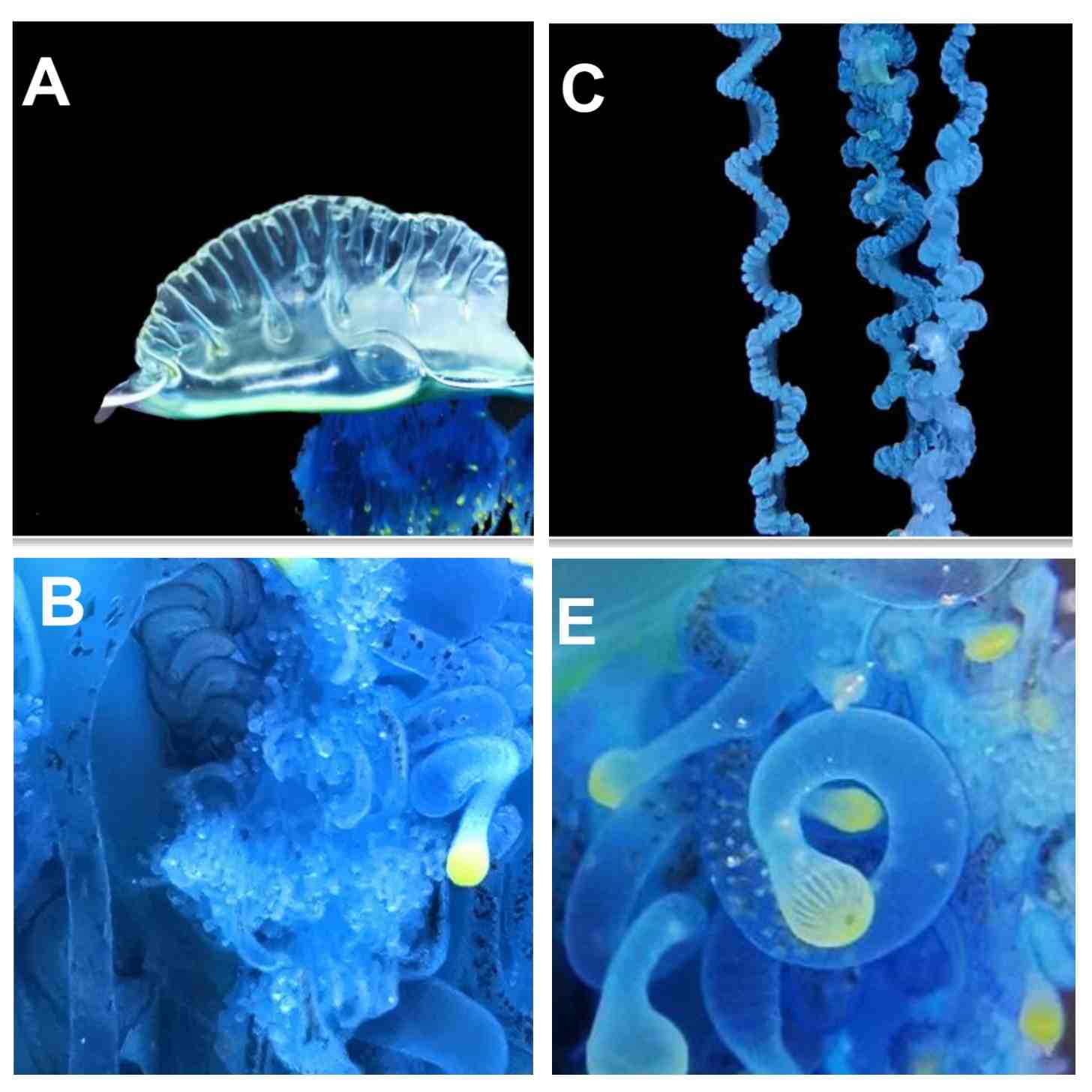
“Our morphological and DNA analyses confirmed that these specimens represent a new species distinct from its tropical relatives,” Kei Chloe Tan said. “[It] is an exciting finding in and of itself, but we still had questions about how it got here.”
To meet their conclusion, the students ran computer simulations on how objects drift in ocean surface currents and speculated that warm water from the far-off Kuroshio Current may have carried the jellyfish to Sendai Bay, where Ochiai had plucked it from the water.
“I ran a particle simulation — which is like dropping bright red beach balls in the water, then making data-based estimations to track where they will end up days or months later,” explained student researcher Muhammad Izzat Nugraha.
“We were excited to find that in our simulation, all the beach balls essentially made a trail from Sagami Bay up to right where we found the ‘crescent helmet man-o-war’ in the Tohoku region.”
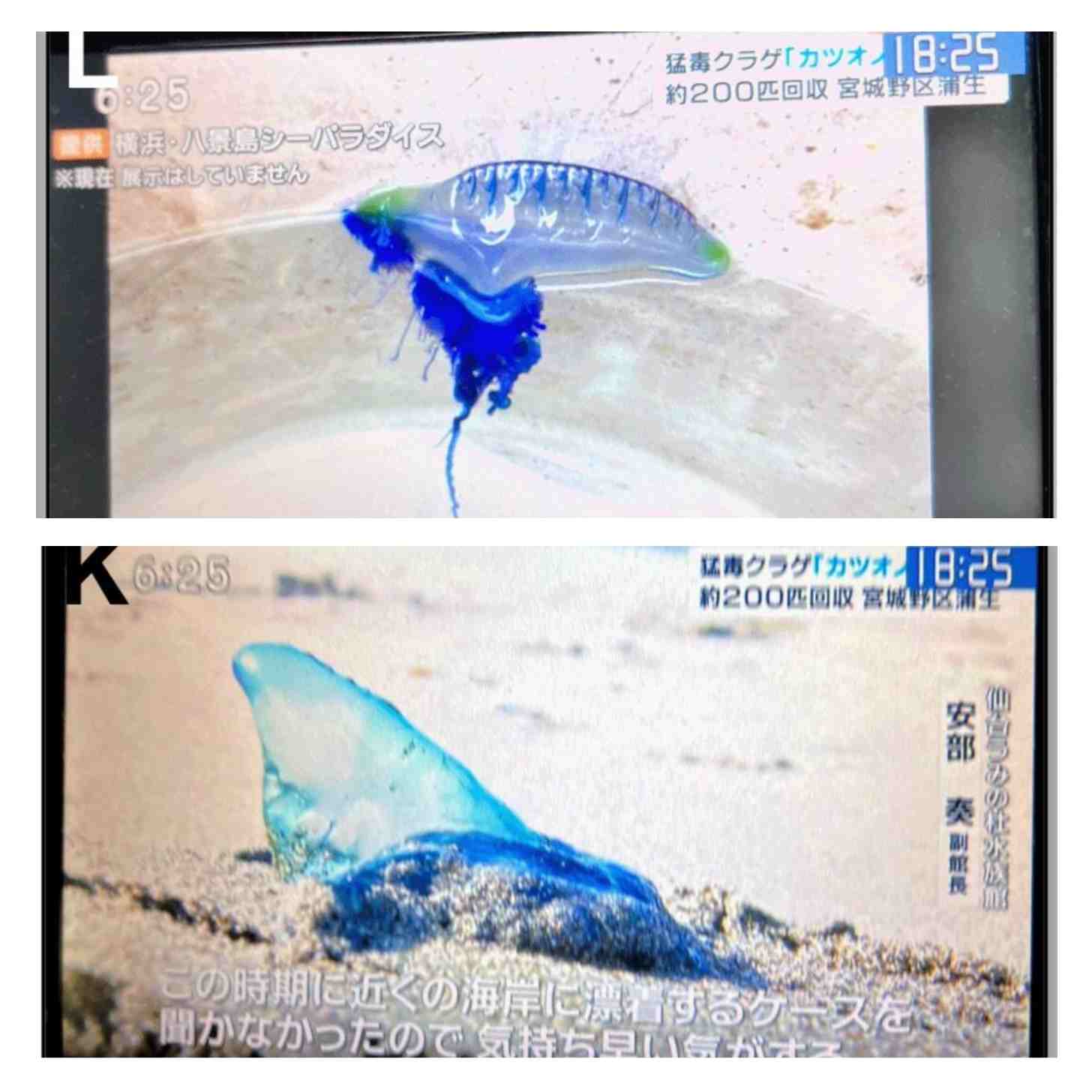
Despite colloquially being referred to as jellyfish by the scientific community — and the world at large — Portuguese man o’ wars actually bear a misnomer. They are not jellyfish but rather a siphonophore: A colony of individual organisms called zooids moving and working together.
Curiously, although each zooid in a colony is morphologically different, they all share identical genes and cohabit as a single individual.
Like many types of jellyfish, Portuguese man o’ wars are highly venomous. Despite the harm they pose to humans, they are quite beneficial to the ocean’s health.
Through nutrient cycling, they redistribute nutrients to lower trophic microorganisms in their environment. They also play an important role in the underwater food web as prey for endangered loggerhead turtles.
“These jellyfish are dangerous and perhaps a bit scary to some,” said student researcher Ayane Totsu. “But [they’re] also beautiful creatures that are deserving of continued research and classification efforts.”
You may also like: A new species of spider with 'never-before-seen features' was discovered in Southern Morocco. It looks like a Pokémon
Header image via Kris Møklebust / Pexels
GoodHeadlines.org curates positive and solution-focused stories from trusted sources around the world.


 The Nationwide Movement Turning Guns Into Garden Tools T he first time Mike Martin held an AK-47 was after the 2012 shooting at Sandy Hook E...
 Why this story matters: This uplifting update reminds us that even in the face of significant obstacles, the human spirit remains resilient...
 The Spark: How to Keep Your Community Cool During Heat Waves Welcome back to The Spark, our monthly newsletter that’s all about how people j...
 Mexico Bans Captive Marine Mammals in Entertainment In a groundbreaking move, Mexico’s Congress unanimously approved a reform to the General...
 Why this story matters: Innovation isn't just about the latest gadget; it's about making life better for everyone. This story highl...
 These Chefs Left Prestigious Culinary Jobs To Cook At Nursing Homes: 'We Want To Make This Industry Better' Facing burnout from his ...
 Why this story matters: While environmental news is frequently dire, there are pioneers quietly solving the most complex problems of our ti...


Please be good and do not spam. Thank you.