
Why this story matters: In this feature, we move past the sensationalism to look at a genuine success story—one that emphasizes collaboration over conflict and results over rhetoric.
Quick summary: This story highlights recent developments related to switzerland, showing how constructive action can lead to meaningful results.
The space between railroad tracks doesn’t usually do much of anything. But in a tiny village in Switzerland, Swiss inventors have spent the last year proving it can be used to generate clean electricity.
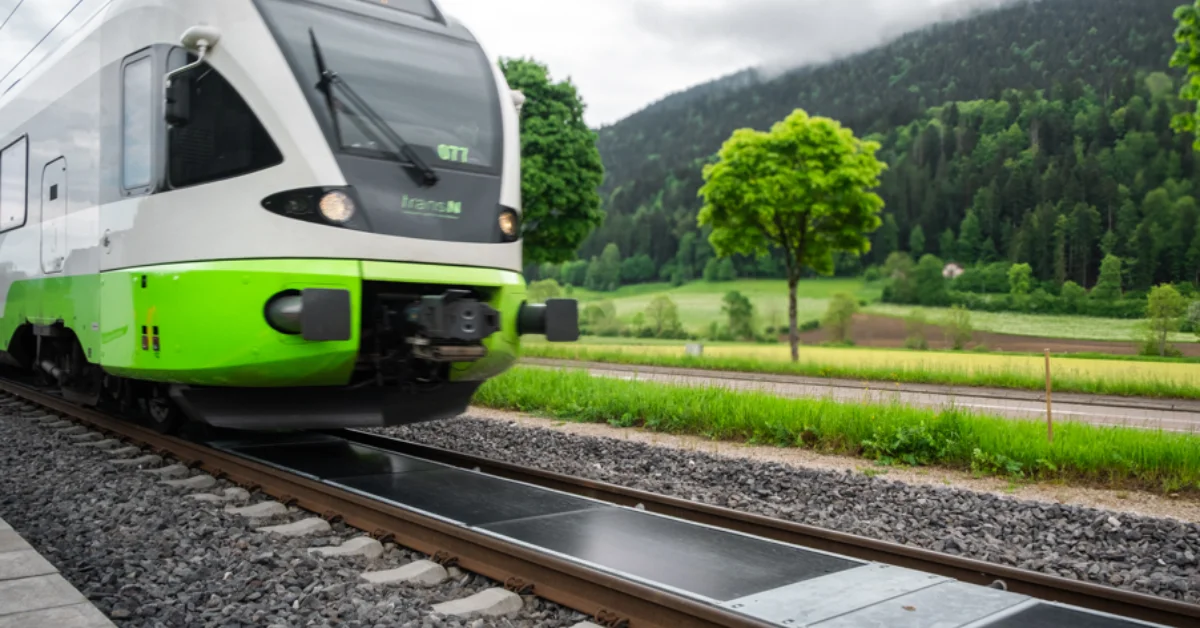
In April 2025, Swiss startup Sun-Ways installed 48 solar panels along a 330-foot stretch of active railway in Buttes, Switzerland. It is the first removable solar power plant on a working rail line anywhere in the world.
The patented panels were designed to sit between the rails and can be easily removed whenever crews need to do track maintenance.
Now, just over a year into their three-year pilot project, the results are in: More than 11,000 trains have rolled directly over the panels at speeds up to 55 mph, and the installation has remained stable, safe, and productive.
“We have achieved our objectives, both in terms of railway safety and electricity production,” Joseph Scuderi, founder of Sun-Ways, told Swissinfo.
Since May 2025, the 330-foot-long installation has produced more than 16,000 kilowatt-hours of electricity — enough to cover the average annual consumption of three to four Swiss households — despite a month-long pause for snow and planned technical work.
What’s the good news?
- The pilot program has proven that unused land — even unconventionally small amounts of land — can be used to generate renewable energy. No need to purchase land, tear down trees, etc.
- The railway solar panels don’t interfere with moving trains or the maintenance crews who work on the tracks.
- Railway solar is expected to expand and spread to new locations.
The future of solar train tracks
The Buttes pilot is officially scheduled to run through 2028, but Scuderi hopes the strong early results will speed things up. “We have demonstrated that the solar plant between the rails is safe,” he said. “The sooner we obtain final approval, the sooner our partners abroad will also be able to move forwards.”
According to Sun-Ways, Switzerland’s roughly 3,300-mile rail network — excluding tunnels and poorly lit stretches — could generate up to 2% of the country’s electricity — enough to power some 300,000 households.
And, of course, railways are everywhere: the same unused space between the rails exists on train lines worldwide. The potential of generating energy in unused railway spaces hasn’t gone unnoticed.
“Last week there was a company from the Indonesian railway sector that came to see the pilot project to convince themselves it was real and not a fake video,” Scuderi told PV Magazine in July 2025.
Scuderi also told PV Magazine there has been some interest from Japan and South Korea, where trains travel at more than 186 miles per hour. In February, France’s national railway company SNCF signed a deal with Sun-Ways. And Scuderi said he’s currently in contact with an Italian railway infrastructure company about organizing a pilot in Italy by the end of the year.
If these pilot projects are successful, this new technology could enable hundreds of thousands of miles of train tracks around the world to generate clean, renewable energy for local communities.
Featured Image: Courtesy of Sun-Ways
BluAZ.com curates positive and solution-focused stories from trusted sources around the world.


 Why this story matters: In an era where the digital landscape is often flooded with polarizing and negative headlines, stories like this se...
 ‘In Goats We Trust’ When Mount Etna in Sicily rumbled this spring, news outlets around the...
 Mexico Bans Captive Marine Mammals in Entertainment In a groundbreaking move, Mexico’s Congress unanimously approved a reform to the General...
 Why this story matters: Positive change rarely happens with the strike of a clock; it is usually the result of tireless dedication. This st...
 Why this story matters: Amidst the constant noise of the modern world, it’s essential to pause and highlight the examples of human kindness...
 Why this story matters: In a world where it is easy to feel overwhelmed by the scale of our problems, stories of localized innovation and c...
 Why this story matters: In an era where the digital landscape is often flooded with polarizing and negative headlines, stories like this se...


Please be good and do not spam. Thank you.