
Why this story matters: While environmental news is frequently dire, there are pioneers quietly solving the most complex problems of our time. This update focuses on a solution that is already showing incredible promise in the field.
Quick summary: This story highlights recent developments related to photography, showing how constructive action can lead to meaningful results.
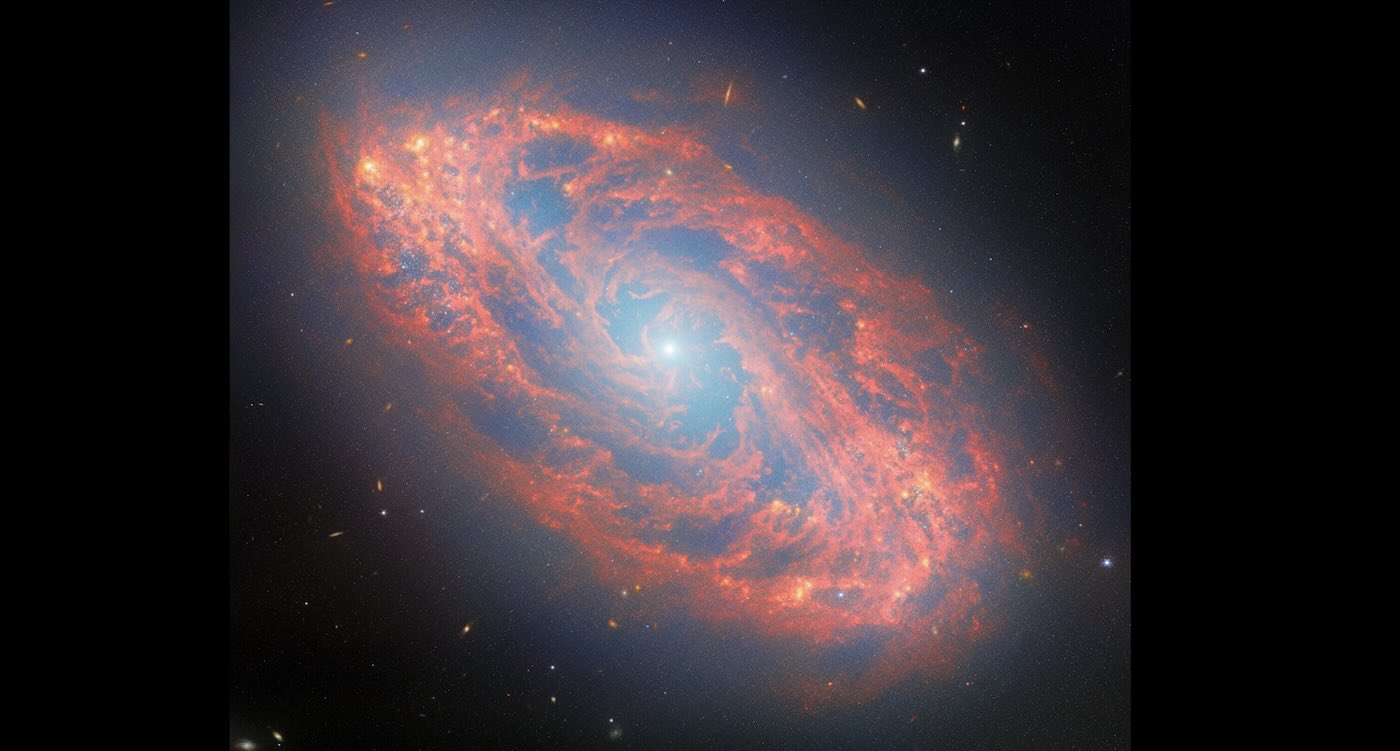
Light which emanated from a spiral galaxy at the same time the Tyrannosaurus rex was dying out on Earth was captured in striking detail by the James Webb Space Telescope.
Two instruments aboard the Webb observatory have combined to create a jaw-dropping image revealing the structure of NGC 5134, the spiral galaxy 65 million light‑years away.
“NGC 5134 is fairly close by, as far as galaxies go,” said a statement from NASA, the European Space Agency, and the Canadian Space Agency.
Would you like to read more good news about Photography, Science, James Webb, Space, and Stargazing?
“Although 65 million light-years may seem like a huge distance, the light that Webb collected to create this image has been journeying to us from since soon after Tyrannosaurus rex went extinct.”
The image, captured last month on February 20, offers a view from the deep past. Studying “nearby galaxies” like NGC 5134, which is in the Virgo constellation, is aiding astronomers in their understanding of far more distant systems that appear only as faint points of light.
The relative proximity of the star system allowed two of Webb’s powerful cameras to join forces to pick out fine detail in the galaxy’s tightly wound arms.
CHECK OUT THIS WILD PLANET: The Lemon-Shaped Planet Where Rain Turns to Diamonds
Webb’s mid-infrared instrument, a versatile camera/spectrograph, shows warm dust and complex molecules across the galaxy’s clouds, while its near-infrared camera, the primary imaging instrument onboard, highlights the stars and clusters embedded within them.
NGC 5134, which was first discovered in 1785 by German-British astronomer William Herschel, has a possible “active galactic nucleus”—a compact region at the center of a galaxy that emits a significant amount of energy across the electromagnetic spectrum, with characteristics indicating that this luminosity is not produced by the stars.
Within this scenic galaxy view, we see the gas clouds that billow along its spiral arms. These are the sites of star formation, and each star that forms chips away at the galaxy’s supply of star-forming gas. When stars die, they recycle some of that gas back into the galaxy.
HABITABLE PLANET? Webb Space Telescope’s First Look at an Atmosphere on Habitable Zone Exoplanet
This give and take between gas and stars is the focus of a NASA/ESA/CSA program that aims to study 55 galaxies in the nearby Universe that are actively forming new stars using a broad range of wavelengths. (See NASA’s higher resolution version of the photo, here.)
“The new Webb data contribute a rich understanding of individual star clusters and star-forming clouds and have already been used to study the life cycle of tiny dust grains, the shape and properties of star-forming clouds, the links between interstellar gas and dust, and the process by which newly formed stars reshape their surrounding environment,” reports NASA.
THIS IS COOL: Trees Synchronize Their Bio-electrical Signals During Solar Eclipses: ‘The Wood Wide Web in Action’
GoodHeadlines.org curates positive and solution-focused stories from trusted sources around the world.


 The Nationwide Movement Turning Guns Into Garden Tools T he first time Mike Martin held an AK-47 was after the 2012 shooting at Sandy Hook E...
 Why this story matters: This uplifting update reminds us that even in the face of significant obstacles, the human spirit remains resilient...
 Why this story matters: Innovation isn't just about the latest gadget; it's about making life better for everyone. This story highl...
 Mexico Bans Captive Marine Mammals in Entertainment In a groundbreaking move, Mexico’s Congress unanimously approved a reform to the General...
 Why this story matters: While it is easy to become cynical in an age of instant, often negative information, stories like this prove that t...
 The Spark: How to Keep Your Community Cool During Heat Waves Welcome back to The Spark, our monthly newsletter that’s all about how people j...
 These Chefs Left Prestigious Culinary Jobs To Cook At Nursing Homes: 'We Want To Make This Industry Better' Facing burnout from his ...


Please be good and do not spam. Thank you.