
Why this story matters: Not all news is bad news. This story highlights the kind of progress that often goes unnoticed.
Quick summary: This story highlights recent developments related to creatures, showing how constructive action can lead to meaningful results.
A new ocean expedition along the coast of Argentina has unveiled 28 species that are completely new to the scientific record.
“We were not expecting to see this level of biodiversity in the Argentine deep sea, and are so excited to see it teeming with life,” said the expedition’s chief scientist, Dr. María Emilia Bravo of the University of Buenos Aires and Argentina’s National Scientific and Technical Research Council.
“Seeing all the biodiversity, ecosystem functions, and connectivity unfolding together was incredible,” she continued. “We opened a window into our country’s biodiversity only to find there are so many more windows left to be opened.”
Would you like to read more good news about Creatures, Its, Onceinalifetime, Van, Longer, and Arms?
During the voyage, which explored the waters between Buenos Aires and Tierra del Fuego, the Schmidt Ocean Institute’s remotely operated vehicle SuBastian explored the largest known Bathelia candida coral reef in the global ocean.
The stony cold-water coral reef, which is roughly the size of Vatican City, is a vital habitat for countless fish, crustaceans, octopuses, and new species.
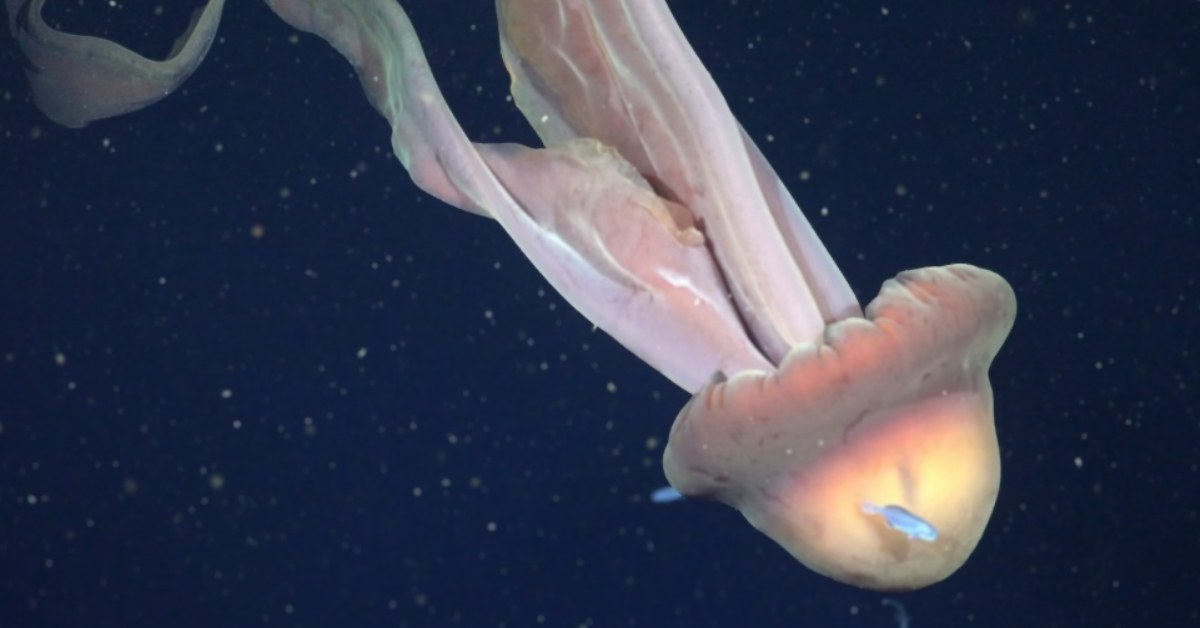
The operation also documented Argentina’s first deep-water whale fall and the extremely rare giant phantom jellyfish — a deep-sea jelly that can grow as long as a school bus, with arms that can reach up to 33 feet long.
Despite their massive size, the jellyfish is incredibly difficult to record. First collected in 1899, they were not officially recognized as a species until 60 years later.

Since that first collection, they have been spotted roughly 120 times (amounting to less than one sighting a year around the globe).
Bravo said that the control room of the research vessel fell completely silent when the bus-sized jellyfish graced their screens.
“There was a mixture of excitement and disbelief,” Bravo told The New York Times. “Its ethereal and delicate presence in such an extreme environment was deeply surprising.”
Bravo added that the jellyfish’s arms, which are longer than a camper van, made it difficult to maneuver SuBastian, but they proceeded with the utmost caution.
“We were curious about getting to know it better and documenting it well,” she said.
For years, Schmidt Ocean Institute’s deep-sea expeditions have been broadening the scientific community’s understanding of the ocean and the countless species that await discovery in the watery depths below.
In August 2025, they garnered global attention when a livestream of their three-week expedition of Argentina’s Mar del Plata Canyon went viral and amassed over 17.5 million views.
During that expedition, they discovered 40 creatures that were completely new to science, including never-before-seen “sea anemones, sea cucumbers, sea urchins, snails, corals, and crinoids.”
Just two months later, the Schmidt Ocean Institute released findings of their 100th expedition, which yielded 30 new species — and hundreds of other species that had never been recorded off the coast of Uruguay.

By Halloween, the Universidad de Magallanes’ Southern Ocean Species Discovery Workshop in Punta Arenas, Chile, published detailed findings on the institute’s biggest discoveries of the year, including new black corals, armored and iridescent scale worms, sea stars, and a “death ball sponge.”
“With every expedition to the deep sea, we find the ocean is full of life — as much as we see on land, and perhaps more because the Ocean contains 98% of the living space on this planet,” Schmidt Ocean Institute’s executive director, Dr. Jyotika Virmani, said after their latest expedition.
She added: “We have been privileged to work with outstanding scientists across three expeditions in Argentinian waters, and look forward to seeing their research continue to unfold, unlocking new understanding and inspiration.”
You may also like: Science students find new species of 'goth ladybug' living on their campus: 'There are unknown species living right beside us'
Header image via ROV SuBastian / Schmidt Ocean Institute
GoodHeadlines.org curates positive and solution-focused stories from trusted sources around the world.


 The Nationwide Movement Turning Guns Into Garden Tools T he first time Mike Martin held an AK-47 was after the 2012 shooting at Sandy Hook E...
 Why this story matters: This uplifting update reminds us that even in the face of significant obstacles, the human spirit remains resilient...
 The Spark: How to Keep Your Community Cool During Heat Waves Welcome back to The Spark, our monthly newsletter that’s all about how people j...
 Mexico Bans Captive Marine Mammals in Entertainment In a groundbreaking move, Mexico’s Congress unanimously approved a reform to the General...
 Why this story matters: Innovation isn't just about the latest gadget; it's about making life better for everyone. This story highl...
 Why this story matters: This story offers a refreshing and deeply necessary look at how practical problem-solving and human ingenuity can i...
 These Chefs Left Prestigious Culinary Jobs To Cook At Nursing Homes: 'We Want To Make This Industry Better' Facing burnout from his ...


Please be good and do not spam. Thank you.