
Why this story matters: While challenges remain, stories like this demonstrate that constructive action can make a real difference.
Quick summary: This story highlights recent developments related to on this day, showing how constructive action can lead to meaningful results.
65 years ago today, Disney Studios released One Hundred and One Dalmatians, an adaptation of a novel by the same named published 5 years earlier. Telling the story of a London-based pair of Dalmatians who give birth to a litter of 15 puppies, and of a obsessive socialite named Cruella de Vil bent on turning their furs into a coat, the film was a box-office and backpages success, with many calling it the best that Disney had achieved since Snow White. READ just how successful it was… (1961)

While not as iconic as other Disney films, when adjusted for inflation, One Hundred and One Dalmatians is the twelfth-highest-grossing film in the North American box office history, and the second-highest-grossing animated film globally, as well as being the highest-selling traditionally animated film of all time, at an estimate of over 199,800,000 sold tickets.
The success of the film made Disney expand it into a media franchise, with a live-action remake released in 1996, followed by a sequel in 2000. A direct-to-video animated sequel to the 1961 film, 101 Dalmatians II: Patch’s London Adventure, was released in 2003. Two animated television series based on the franchise were also produced, with 101 Dalmatians: The Series in 1997 and 101 Dalmatian Street in 2019. A live-action reboot, Cruella, starring Emma Stone, was released in 2021.
Would you like to read more good news about On This Day and This Day In History?
MORE Good News on this Date:
- City of São Paulo founded in Brazil (1554)
- The Wedding March by Mendelssohn was played at the marriage of Queen Victoria’s daughter and became a favorite recessional (1858)
- The United Mine Workers of America was founded in order to improve working conditions and wages for coal miners (1890)
- AT&T completed the first transcontinental telephone call in the US (1915)
- Pope John Paul II demanded the release of political prisoners during a historic visit to Cuba (1998)
62 years ago today, the Blue Ribbon Sports company was founded in Oregon. Remaining so named for the next 7 years, it would eventually change to a new moniker: Nike. The world’s largest supplier of athletic shoes and apparel and a major manufacturer of sports equipment, with revenue in excess of US$46 billion, Nike took its name from the Greek goddess of victory.

If it can be believed, Blue Ribbon Sports got its start selling shoes manufactured in Japan by a company called Onitsuka Tiger. Most pairs were sold out of the back of the automobile of University of Oregon track athlete Phil Knight, co-founder of Nike. Knight’s coach, Bill Bowerman, used his wife’s waffle iron to experiment on rubber to create a new sole for track shoes that would grip but be lightweight and increase the runner’s speed.
Bowerman’s design led to the introduction of the “Moon Shoe” in 1972, so named because the waffle tread was said to resemble the footprints left by astronauts on the Moon. Further refinement resulted in the “Waffle Trainer” in 1974, which helped fuel the explosive growth of Blue Ribbon Sports/Nike.
A runner brought in to help with branding came up with the name Nike, and the “Swoosh” logo was first used by Nike on June 18th, 1971, with a trademark being registered in 1974. Another major milestone came in 1979 when the company designed its first professional sporting product: the kits for the Portland Timbers Major League Soccer club. (1961)
141 years ago today, one of the most influential modern poets in Japanese history, pen name Hakushu Kitahara, was born. The man published over 200 books of children’s stories and poetry in his life, as well as worked as editor for several literary magazines. There was no slow grind for Kitahara; his first two books launched him into literary limelight. The second of which, Jashumon took the poetry world by storm with its innovative structures.

Every year in his hometown of Yanagawa, a festival is held in November to honor the poet. Stages are set up along the canal, with criers reciting various Kitahara poems to passersby. The following poems are in the Waka, or Tanka form of Japanese poetry, which is made with a syllabic structure of 5-7-5-7-7 (1885)
How sad is
The road man must take
The road to prison
The pebbled road down which
a police wagon creaks
I can hear so faintly
My mother and father
Awake
Whispering
Dawn after a snowfall
I climb a hill
With a fish over my shoulder
The purple flowers
In the potato fields
Are now in full bloom
We are well into spring
And I have thought of peonies
For several days now
How many years have passed
Since my eyesight failed?
On this day 267 years ago, Robert Burns, aka the “Ploughman Poet,” aka the “National Bard,” was born. Few outside Scotland, the UK, or poetry classes will know the name by heart, but the man who Scottish television voted “The Greatest Scott,” over even the likes of William Wallace, lives on as poets often do: in their language. For example, who could mistake the lyrics to Burn’s poem and song “Auld Lang Syne” sung on the final day of the year? How many have read John Steinbeck’s classic Of Mice and Men or heard the phrase “the best-laid plans of mice and men,” without knowing the Scotts words “Gang aft agley,” (often go awry) which first ended that phrase?
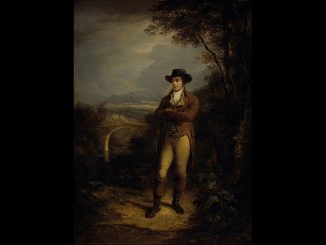
Burns grew up on a farm where he toiled daily and took a liking to the plants and animals of the rural environment, hence his “ploughman” moniker. His first collection of poems in the Scotts language, the Kilmarnock volume, was originally designed only to earn him some pocket money for his trip to Jamaica. Containing poems like Address to the Deil, Halloween, The Cotter’s Saturday Night, To a Mouse, Epitaph for James Smith, and To a Mountain Daisy, it was an instant hit, and garnered recognition from “a set of critics for whose applause I had not dared to hope,” Burns wrote.
The poems contained the narratives of a cultured and pensive farmer remarking on the land, for example in his famous To a Mouse, “I’m truly sorry man’s dominion, Has broken Nature’s social union.” Utterly Scottish, he would write Address to a Haggis, in which he describes the classic Scottish dish as “Great chieftain o’ the puddin-race!”
After some years in Edinburgh, he would return to farming, this time in Dumfriesshire, and write his narrative masterpiece Tam o’Shanter, which is a jolly and mischievous poem about a man coming drunk upon a haunted church filled with witches, warlocks, and the devil playing the bagpipes. Watching in wonder they eventually chase him down the road, where Tam escapes just barely with one demon pulling his horse’s tail off. The poem ends with a warning about going drinking. (1759)
Now, wha this tale o’ truth shall read,
Ilk man and mother’s son, take heed:
Whene’er to Drink you are inclin’d,
Or Cutty-sarks rin in your mind,
Think ye may buy the joys o’er dear;
Remember Tam o’ Shanter’s mare
Listen to To a Mouse recited by a Burns Historian…
And on this date in 1890, pioneering journalist Nellie Bly completed a record-breaking trip around the world in 72 days, to prove that Jules Verne’s fictional journey (“Around the World in 80 Days”) could be achieved. She traveled the 24,899 miles, mostly alone, using steamships and trains, wearing only the dress on her back, a sturdy overcoat, and carrying a small travel bag with toiletries and underwear.
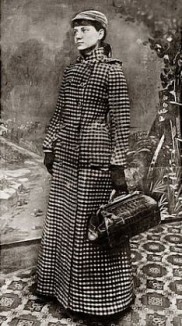
While circumnavigating the globe for her newspaper, modern submarine cable networks and the electric telegraph allowed Bly to send short progress reports, although longer dispatches had to travel by regular post and thus, were delayed by several weeks. Nellie Bly, whose real name was Elizabeth Jane Cochrane, first became renowned for her undercover investigation on insane asylum conditions, during which she pretended to be mad. Her expose led to a grand jury investigation and $850,000 in increased funds to care for the insane.
Her career began when she was 16, after a misogynistic column, “What Girls Are Good For,” ran in the Pittsburgh Dispatch and prompted her to write a fiery anonymous rebuttal to the editor. He was so impressed with her passion that he ran an advertisement asking the author to identify herself. When Ms. Cochrane introduced herself to the editor, George Madden, he offered her the opportunity to write a piece for the newspaper. (Nellie wrote books about her experiences, and there are stories for children about her trip.)
Happy 44th Birthday to Alicia Keys, the American singer-songwriter and classically-trained pianist who was signed to a major record deal at age 15. A unique blend of ‘Neo Soul’ and R&B, her debut album, Songs in A Minor, with its No.1 single Fallin’, sold over 12 million copies worldwide, and earned the 18-year-old five Grammy Awards.

Growing up without a father in Hell’s Kitchen, New York City, Keys credits her mother’s tenacity and self-reliance for anchoring her on the right path, unlike many people she grew up with who ended up on the wrong path or in jail.
In total, she’s won 15 Grammys and sold over 50 million albums. During 2020, she released her seventh studio album, Alicia, and published a new book about personal transformation, entitled, More Myself: A Journey.
Keys is also acclaimed for her humanitarian work, is the co-founder of the nonprofit HIV/AIDS-fighting organization Keep a Child Alive, and raised money last year for COVID-19 relief. WATCH a sweet video from lockdown… (1981)

And, 65 years ago today, Bubble Wrap was invented. Although it failed in its original purpose as a textured wallpaper, it became a popular shipping insulation. Afterward, one of the inventors Alfred Fielding co-founded the Sealed Air Corporation and received a trademark on the name bubble wrap. The protruding air-filled bubbles, which can be popped, also became a fascination for children—and the young-at-heart. (1960)
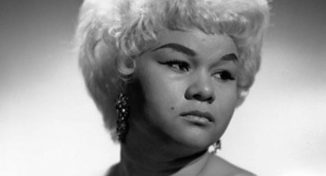 Also, on this day in 1938, the great blues singer Etta James was born in Los Angeles. Her iconic 1960 hit “At Last”, often played at weddings, was among 9 US Top 40 hits that earned her multiple awards.
After that debut hit album, she faced a number of personal problems, including heroin addiction, severe physical abuse, and incarceration, before making a musical comeback in the late 1980s. In April 2009, at the age of 71, James made her final television appearance before succumbing to leukemia, performing At Last on Dancing with the Stars. WATCH her perform the song at her induction into the Rock Hall of Fame…
[embedded content]And, on this day in 1919, the Paris Peace Conference decided to create the League of Nations and proceeded to draft a Covenant that 44 states would sign five months later. Its primary goals, as stated in its Covenant, included “preventing wars through collective security and disarmament, and settling international disputes through negotiation and arbitration.”

GoodHeadlines.org curates positive and solution-focused stories from trusted sources around the world.


 The Nationwide Movement Turning Guns Into Garden Tools T he first time Mike Martin held an AK-47 was after the 2012 shooting at Sandy Hook E...
 The Spark: How to Keep Your Community Cool During Heat Waves Welcome back to The Spark, our monthly newsletter that’s all about how people j...
 Why this story matters: Behind the headlines, stories like this show how real-world solutions are taking shape. Quick summary: This story ...
 Mexico Bans Captive Marine Mammals in Entertainment In a groundbreaking move, Mexico’s Congress unanimously approved a reform to the General...
 Why this story matters: This story offers a refreshing and deeply necessary look at how practical problem-solving and human ingenuity can i...
 Why this story matters: While environmental news is frequently dire, there are pioneers quietly solving the most complex problems of our ti...
 Why this story matters: It is often said that bad news travels fast, but good news has a deeper impact. This story explores a quiet victory...


Please be good and do not spam. Thank you.